The Weight of Belonging and The Fragility of Home

On Saturday, I was at a photo festival in Naarden. It was excellent! Thank you, Alexandra, for taking me there!

I also liked the theme: Home.

These photos standing in the middle of the grassy fort are the two I really like.
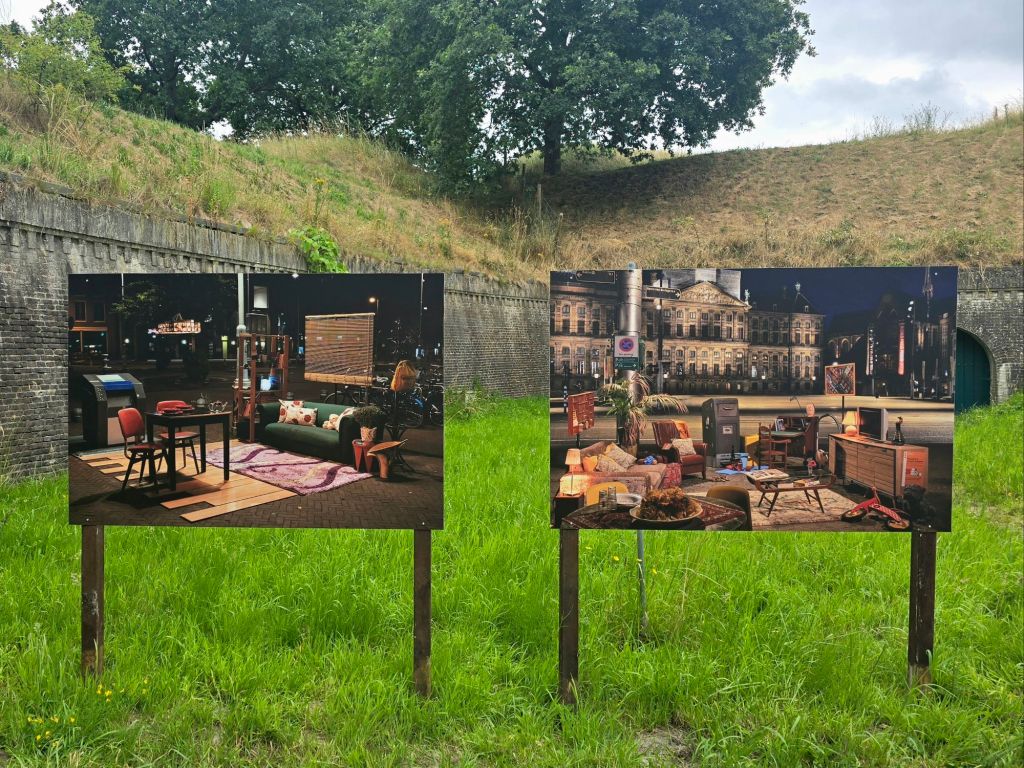
Each image showed a complete living room setup, placed not inside a house or building but out on the streets at night. Rugs, couches, lamps, bookshelves, everything carefully arranged and staged, absurdly cosy, and entirely exposed.


A living room without walls

I stood there, trying to decide whether I found it beautiful, ridiculous, or painfully familiar. Maybe all of them?

I felt fascination because they were beautiful and bold. I felt resonance and sadness, because they mirror my efforts to build “a life” in places (or systems) that will never truly contain me. I also felt admiration because they show vulnerability and what comfort means in the middle of chaos.

For me personally, somehow, these photos feel more familiar than the exhibition where they display a lot of portraits of immigrants.

A False Sense of Shelter

Is this idea where safety dragged into public place, a home?

Is it still a home when placed outside the boundaries of safety?

Is “home” a space, or is it just the act of pretending we belong somewhere?

Can we really ever make a home in this transient, collapsing world?
For me, who has spent most of my life not feeling like I belong, a home is a fragile thing.

I ask myself a lot, what does it mean to belong when you always feel slightly misplaced, no matter where you stand, anyway?

I moved countries, rebuilt my life, and questioned systems, identity, and purpose. These photos hit too personal. Like an attempt I know too well.

No matter how much I don’t feel human, I am after all, a human. And the human needs to belong, to anchor meaning, in a world that offers no guarantees.

In so many ways, I now feel more “at home” here, among strangers, in a different language, than I ever did in my so-called home country, or even among family. And yet, that feeling doesn’t really sit in stone, it wobbles on shifting ground.

The feeling of belonging… will it ever come?

Or is it just another room I decorate in my solitude, knowing I may never stay?

So what and where is home, really?

Maybe home is something we build because the world is indifferent and won’t offer us one?

Maybe it’s an act of rebellion against impermanence? An absurd ritual we repeat, over and over, to insist that something can be ours, even in a world that never really belongs to us?

Maybe it’s the ache that reminds me that I’m  still searching?

Or the fragile peace that comes from accepting I might never fully arrive?
Misanthropy and anti-natalism are probably not really hate, but disappointment

People often think that being an antinatalist and a misanthropic is a bad thing and dismiss them as mere bitterness and hatred.

But what if they stem from compassion? A twisted kind, yes, but compassion nonetheless? 🤣

Let me explain to you why:

You start by holding humanity to a higher standard. You put the human race on a higher pedestal. You expect them to care, to be compassionate, and to care about things beyond physical gratifications and instinct.

Yet reality rebukes you, again and again, until you see the truth: this world is a futile, self-devouring machine. A hell that churns out misery while the masses shrug, indifferent to the ruin they perpetuate.

Then you inevitably are continuously disappointed with the reality and maybe even indirectly rebuked about why you’re here.

You fall into deep contemplation until you realize that this is such a futile, meaningless, and wrecked world. You realise it’s such a hellish place that won’t stop excreting so much misery, sorrow and despair, and you live among humans who don’t even put consideration on the damage they are causing in the future and the unspeakable deterioration they perpetuate.

The universe is just an uncaring and indifferent mass of emptiness. The universe doesn’t care and it should be okay, but these people also don’t. And life itself will always generate a selective pyramid with the few on top and the great majority at the bottom, who, being frail, have to pay the biggest bill and take on the worst parts of other forms of suffering besidesthe existential problems themselves.

You have to agree with being a slave to capitalism, being part of the plague called the human race, and dealing with those with decomposing flesh whom you cannot trust anymore.

Now you understand that life is actually not the opposite of death but the death’s waiting room, so it’s a good idea to not bring more children into this unnecessary suffering, agony, and misery.

Why drag more souls into this cesspool of agony? The only mercy is refusing to propagate it. The only true reduction of suffering? The end of sentience itself.

You think that so much endless and needless suffering could be avoided by complete extermination or disappearance of sentient life from the face of the cosmos.

When people hear anti-natalism, they sneer, “If life is so bad, why don’t you kill yourself?”.

But suicide doesn’t fix suffering. It just removes one witness. Anti-natalism isn’t about self-destruction but about preventing future pain.

Suicide is really an inefficient way of reducing the net amount of suffering in this world.

Of course, the real issue is this: not everyone sees the world as a hellscape.

Most don’t smell the slaughterhouse, they just learned to love the taste of meat. Most won’t question the feast, they’re just too busy swallowing.

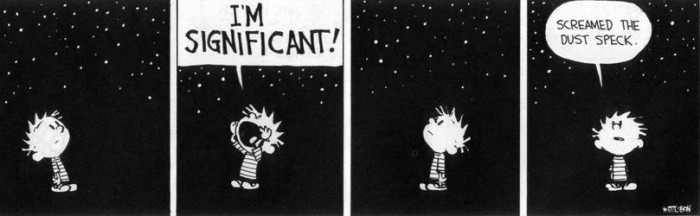
LOOK AT ME!!

“HEY LOOK AT ME!!!” as we screamed from a tiny corner on a speck of dust circling a small star, one of billions in a galaxy, one of billions in space.. but even a single solitary solipsist narcissistic person is really really insignificant in the grand scale of the universe.

The universe doesn’t just ignore us. It renders us mathematically insignificant.

13230131_766375370130279_402663221074683884_n

Life is Short

Life is short they said.
While we perish, history licks a finger and turns the page.
While we vaporized quickly, the universe keeps laughing at its cosmic joke.
While we spark briefly, we’re all also flying at incredible speed into the endless darkness of the unknown.
But if life is really, really short, then why do some moments seem to flatten out into endless streams?